
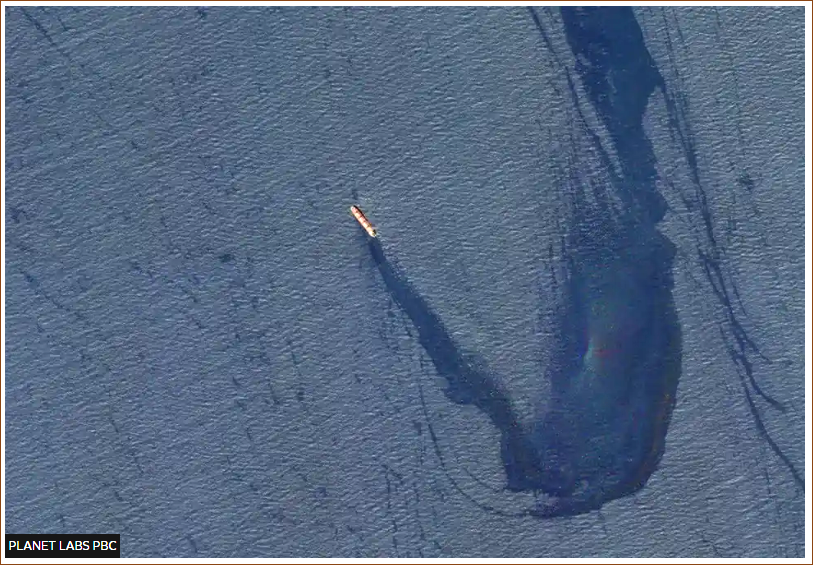
Indian Cargo Ship Sinks in Red Sea Following Attack Off Yemen Coast
An Indian cargo ship sank in the Red Sea on Tuesday after being struck off the coast of Yemen. This incident marks the first loss of a vessel in this area since the Houthi group renewed threats last month against ships associated with Saudi Arabia.
The ship, named MSV Faize Noore Oliya, capsized about 13 nautical miles south of the Houthi-held port city of Hodeidah. Fortunately, rescue workers from Yemen’s internationally recognized government were able to recover all 14 crew members, consisting of 13 Indians and one Yemeni. They were safely brought to the port of Mokha. India’s foreign ministry condemned the “unprovoked” attack and urged for the safe passage of ships in the region to be restored quickly.
While no group has officially claimed responsibility for the attack, shipping data reveal that the vessel had been in contact with Saudi ports. Analysts suggest that the attack fits a pattern indicating a possible suicide boat assault, which aligns with Houthi warnings last month about targeting vessels linked to Saudi Arabia and disrupting traffic in the Bab al-Mandeb Strait.
Although the Houthis have not commented on this specific incident, Yemen’s internationally recognized government has accused them of using an explosive-laden boat for the attack.
This sinking comes at a time when Israel’s Navy is conducting extensive training exercises along its coast and into the Red Sea near Eilat. The drills simulate various scenarios, including attacks on crucial maritime assets. This follows recent threats from Iran’s Islamic Revolutionary Guard Corps aimed at Israeli interests at sea and comes amid previous Iranian operations targeting U.S. military naval infrastructure in the Gulf.
For Israeli defense planners, the navy’s mission extends beyond securing Israeli shipping. Protecting this waterway is crucial since it accounts for about 12% of global shipping and 10% of oil flows through the strategic strait.
A Gulf state official mentioned that the Israeli Navy can effectively deter threats from Iran and its allies. This comes as reports indicate increased cooperation between the Israel Defense Forces (IDF) and regional military forces, including meetings between senior officials from Israel and Gulf countries.
Israel’s presence in the southern Red Sea is growing. Recent news from Somaliland, a region recognized by Israel on the Gulf of Aden, points to Israeli military activities. Discussions regarding a potential base near the strategic port of Berbera could give Israel a closer position to monitor and disrupt Houthi operations before they escalate in the open water.
The shipping route has faced significant challenges before. Since the Houthis began targeting vessels in November 2023, container traffic through the Suez Canal plummeted by as much as 90%. Even a year later, traffic remains approximately 60% below pre-crisis levels. With the recent threat from the Houthis to blockade Saudi-linked vessels, there are growing concerns of another wave of disruptions just as the shipping corridor appeared to be recovering.
Tuesday’s attack highlights that the threat to shipping in the Red Sea is far from over. Israel’s increased naval activities in the region signal its intention to play a role in ensuring maritime safety.
