
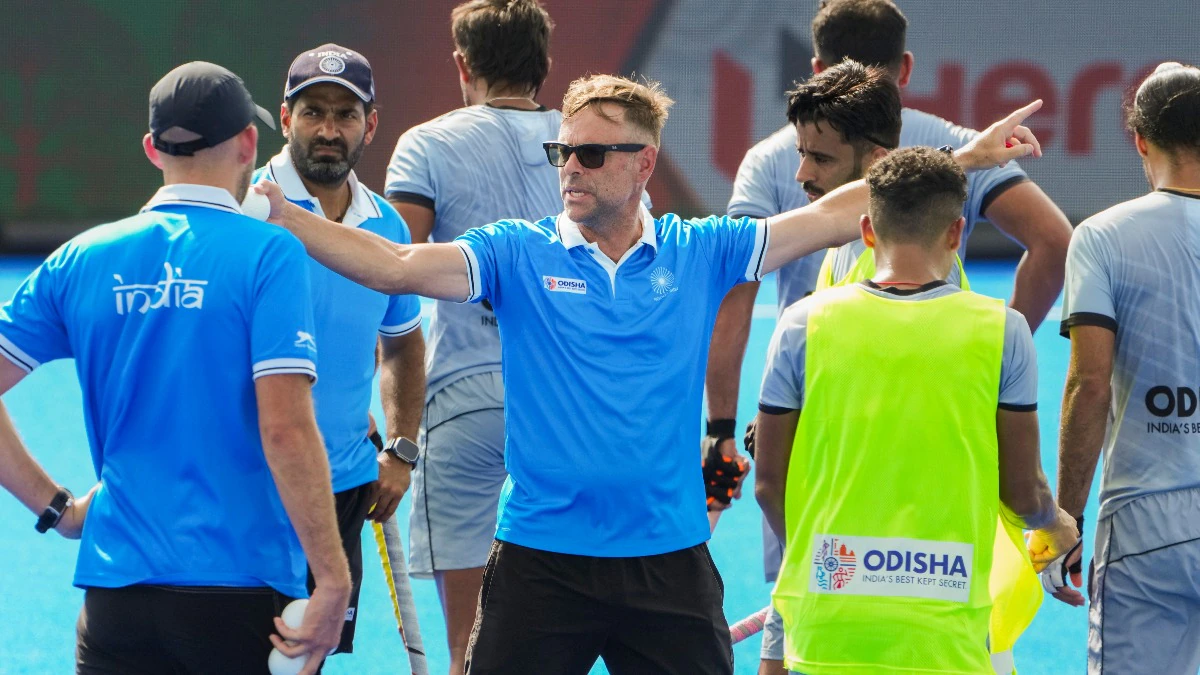
India’s World Cup Squad: A Brave New Direction
Choosing a squad for the World Cup in India is no easy task, especially in a country where failure can lead to intense criticism. Craig Fulton, the head coach, has taken a thoughtful approach to selecting his team, focusing on both current needs and future potential. His decision to include rising stars like Yashdeep Siwach and speedy Aditya Arjun Lalage over more experienced players has surprised many hockey fans. However, Fulton has solid reasons for this shift.
“Yashdeep is flexible and can play in both defense and midfield, making him a key player for us,” Fulton explains. “Aditya is also vital for building our team for the upcoming Olympics in Los Angeles. We have seasoned players like Raj Kumar Pal ready as backups, but it’s important for young talents like Aditya to gain experience under pressure.”
The forward line is a mix of experience and energy, featuring veterans like Mandeep Singh, who is playing in his fourth World Cup, along with Sukhjeet and Dilpreet. Shilanand Lakra, returning from injury, adds an exciting element to the attack. Though it’s his first World Cup, the coach believes Lakra has the skills needed to surprise opponents.
“I prefer to think of it as ‘focus’ rather than ‘pressure,’” Fulton says. “We don’t avoid pressure; we embrace it. Shilanand is incredibly fast and talented with both hands. He’s calm off the field and has the potential for brilliant moments. That’s what we’re aiming for.”
India finds itself in Pool D, competing against England, Wales, and their traditional foe Pakistan. The team enters the tournament with strong recent performances in the Pro League, where they secured five wins out of eight matches. While many see this as a promising sign, Fulton warns against complacency.
“We set both ambitious and practical goals,” he admits. “We want to win every tournament we enter. Currently, we’re ranked seventh or eighth in the world, and some analysts give us only a 5% chance of winning. That’s fine. We can approach the tournament without the spotlight for now.”
Fulton faces an added challenge with a tough international schedule. Just two weeks after the World Cup, India will compete in the Asian Games, which is crucial for Olympic qualification.
“European teams wouldn’t accept playing a World Cup followed by an Olympic qualifier in such a short time,” Fulton laughs. “But we’ve developed a solid pipeline of talent. Our programs for young players are closing the gap, ensuring our intensity and fitness remain high.”
Concerns about India’s performance in crucial matches stem from their reliance on captain Harmanpreet Singh for penalty corners. His success often dictates the team’s ability to score. Fulton has worked hard to diversify their scoring options.
“Scoring from penalty corners is tougher today due to fast defenders,” Fulton observes. “Harman is exceptional, but we can’t depend only on him. We now have four other players—Jugraj, Sanjay, Rajinder, and Amit—who can also take these shots, allowing us to score from various sources.”
By distributing responsibilities among five drag-flickers, India hopes to be less reliant on any one player. This strategy is part of Fulton’s effort to minimize uncertainty.
Since Craig Fulton took over, optimism has surged in Indian hockey. His experience as an assistant coach for the successful Belgian team brings a winning mindset. Indian hockey has struggled for years, often swinging between highs and lows. Fulton brings a clear plan—one based on structure and tactical discipline.
The results speak for themselves, with an Olympic bronze and golds in regional competitions re-establishing India’s standing. Yet, the hunger for success continues. The ultimate goal remains: breaking a 51-year drought since India last reached the World Cup semifinals.
Fulton is a coach who thinks deeply about every game. With his past experience and current role alongside Dilip Tirkey, the President of Hockey India, he’s committed to achieving success for the team. His calm demeanor is reflected in the way he builds a squad that balances strong defense with a potent attack.
Critics sometimes label Fulton’s style as overly cautious, but he counters that it’s about necessity, not fear. “When Spain won their World Cup, they conceded just one goal,” he explains. “If you have a solid defense, it opens up many attacking opportunities.”
His approach focuses on smart play and quick execution. Unlike previous Indian teams that often fell to dominant opponents, Fulton’s strategy forces rivals into tight spaces, turning turnovers into fast breaks.
Watching Fulton during a match is like observing a master strategist. He meticulously prepares every tactic and revises plans based on analysis. Yet even a coach so dedicated to the sport knows he needs downtime to manage the demands of his role.
“This job is always on my mind,” Fulton admits. “I only truly switch off when I talk to my family back home or play a round of golf. It helps me recharge.”
After countless hours of training and planning, India is set to take the field, eager to shift the narrative of the last five decades. For Fulton, the focus is clear: actions speak louder than words, and the outcome will reveal the truth of their hard work.
World Cup Squad
Goalkeepers: Mohith HS, Suraj Karkera
Defenders: Jarmanpreet Singh, Harmanpreet Singh (c), Amit Rohidas, Jugraj Singh, Sanjay, Sumit, Yashdeep Siwach
Midfielders: Rajinder Singh, Aditya Arjun Lalage, Hardik Singh, Manpreet Singh, Nilakanta Sharma, Vivek Sagar Prasad
Forwards: Dilpreet Singh, Shilanand Lakra, Sukhjeet Singh, Mandeep Singh, Abhishek
