
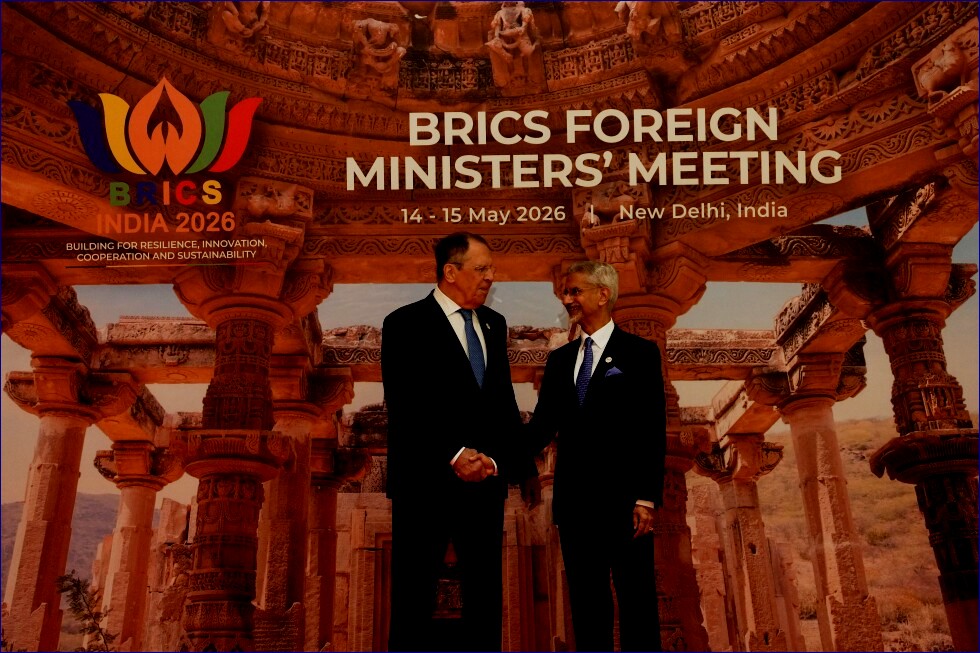
BRICS Foreign Ministers Meet in New Delhi Amid Global Uncertainties
NEW DELHI — The foreign ministers of the BRICS nations convened in New Delhi on Thursday for a two-day meeting. This gathering comes at a time when the bloc is facing significant challenges, including tensions related to the ongoing war in Iran, increasing energy costs, and a broader sense of economic instability worldwide.
Diplomats from Brazil, Russia, India, China, and South Africa joined representatives from newer member countries. The discussions are particularly timely, as the conflict in Iran has led to disruptions in global energy supplies and a spike in oil prices. This meeting also coincides with U.S. President Donald Trump’s visit to China for talks with President Xi Jinping.
Notably, Iranian Foreign Minister Abbas Araghchi and Russia’s Foreign Minister Sergey Lavrov were present, while China was represented by Ambassador Xu Feihong, as Foreign Minister Wang Yi remained in Beijing during the U.S.-China discussions.
Indian Foreign Minister Subrahmanyam Jaishankar emphasized that the meeting would address global challenges and explore ways for BRICS nations to enhance cooperation. In his opening remarks, Jaishankar highlighted that BRICS could play a crucial role in helping developing nations tackle issues related to health, financing, and the rising costs of energy, food, and fertilizers.
“This is a time of significant changes in international relations,” Jaishankar stated. He noted that emerging and developing countries are looking to BRICS for a constructive and stabilizing influence.
Iran Calls for BRICS Solidarity Against U.S. and Israel
During the meeting, Araghchi urged BRICS members to publicly condemn the U.S. and Israel for their actions against Iran, which he described as “unlawful aggression.” He called for concerted efforts to halt warmongering and put an end to perceived impunity for breaches of international law.
Araghchi requested that BRICS nations take stronger actions and avoid politicizing global institutions. He emphasized the necessity of reducing U.S. dominance, stating, “This sense of superiority has no place in today’s world.”
BRICS Aims for Greater Influence
Originally formed by Brazil, Russia, India, and China, BRICS was created as a counterbalance to Western-led organizations like the G7. South Africa joined in 2010, and the bloc has since expanded, welcoming Egypt, Ethiopia, Iran, and the UAE in 2024, with Indonesia becoming a full member in 2025.
BRICS is working to enhance its footprint on the global stage, seeking a more significant role in a world long shaped by the United States and its allies. The group has garnered support from many nations in the Global South, which have often criticized Western financial systems.
However, significant differences continue to exist among BRICS nations.
India and China remain competitive in pursuing regional influence, and their approaches can vary in relation to Western countries. Tensions from Russia’s ongoing war in Ukraine have further highlighted these divides.
Divisions Challenge Global Goals
The recent expansion of BRICS has brought about new strains, with competing regional interests complicating the bloc’s ability to present a united front.
Recent Middle Eastern conflicts have intensified these divisions. Despite being BRICS members, Iran and the UAE often find themselves on opposing sides in the region.
Iran’s deputy foreign minister expressed that internal disagreements have hindered the bloc’s ability to adopt a cohesive stance on the ongoing conflicts. He indicated that advocacy for a statement condemning Iran by one member has made consensus difficult.
“Iran hopes for the success of India’s BRICS leadership. It’s crucial that we don’t portray BRICS as divided,” he remarked, referring to the internal pressure regarding the treatment of Iran.
This meeting represents both an opportunity for cooperation and a challenge for the BRICS nations, as they navigate their diverse interests on the global stage.
