

The Patel Legacy in America’s Motel Industry
For many years, the name "Patel" has become almost a brand in the American motel scene. Across the United States, from simple inns to mid-range accommodations, a significant number of these motels are owned and managed by members of the Patel community, an Indian ethnic group.
This surname represents more than just a name on a sign; it symbolizes migration, hard work, and success.
A New Beginning
In Surat, a city in western India, 73-year-old Rameshbhai Patel reflects on when he decided to leave India in 1965. “I received a letter from my cousin,” he shares, looking at an old letter. “He told me there were cheap motels for sale in California and said, ‘Come.’ So, I did.”
Rameshbhai was part of the early wave of Gujaratis, especially Patels, who moved to the U.S. after the 1965 Immigration and Nationality Act. This new law allowed more immigrants from Asia to come to America, opening doors for many skilled workers and their families.
Upon arriving, many Patels began working at motels, often handling front desk duties, cleaning rooms, and managing daily operations. Over the years, this initial workforce transformed into owners, creating a powerful network of motel proprietors.
Building a Path from Surat to San Francisco
The journey from Surat to San Francisco became a familiar route for many. Relatives sponsored each other, creating a chain migration that supported growth and investment within their community.
Most immigrated with little money but contributed hard work. Kamlesh Patel, who now owns six motels in California, remembers those days. “We slept in storage rooms and cooked on hot plates,” he recalls. “Every family member pitched in.”
Their approach was straightforward: buy struggling motels, live modestly, and reinvest earnings back into new properties. By pooling resources and sharing knowledge, the Patels built a cooperative culture that fueled their expansion.
The Rise of the ‘Patel Motel Network’
By the 1990s, the presence of Patels in the motel business was so widespread that many travellers started calling it the "Patel Motel Cartel." Although it wasn’t an official organization, it highlighted the significant role Patels played in the industry.
Today, almost 70% of Indian-American motels in the U.S. are owned by Patels, and a large portion of budget motels are managed by them, primarily from Gujarat. Dr. Pawan Dhingra, a sociologist, notes that Patels succeeded by seeing opportunities in properties others overlooked — often rundown or far from popular areas.
The Evolving Dream
As the years passed, newer generations of Patels took on the family business. While some pursued careers in fields like medicine and law, others sought to modernize the motel industry.
Aarti Patel, whose parents owned a motel in Fresno, studied hospitality management before returning to help grow the family’s business. “We’ve updated our systems and focused on sustainable practices,” she states. “But at our core, it’s about family, service, and dedication.”
The transition from family-run motels to more professional operations is changing the landscape. Many Patel-owned motels are now part of larger hotel chains.
Giving Back to the Community
As they achieved success, many Patel families also began to give back. They contribute to projects in Gujarat, funding schools, hospitals, and essential infrastructure. In America, they have supported various causes, including disaster relief and education.
Cultural centers and community organizations established by the Patel diaspora are now integral to cities like San Francisco, Dallas, and Chicago. Sociologist Vineeta Gupta emphasizes how the Patel experience reflects broader immigrant challenges and successes, marked by strong community ties and mutual support.
Facing New Challenges
Despite their achievements, Patel motel owners now face significant challenges. Rising property prices, competition from large corporate chains, and shifts in tourism trends due to online booking sites present hurdles.
Younger generations are exploring different career paths, raising questions about the motel industry’s centrality to their identities.
But for pioneers like Rameshbhai, the journey speaks for itself. He recalls, “I arrived with just $100 and no grasp of English. Today, my grandchildren are getting educated in top universities. This is our legacy — built one room, one guest, one day at a time.”
It’s a quiet evolution driven not by headlines but through perseverance, hard work, and the hope for a better future.
Capturing the Essence of the Journey
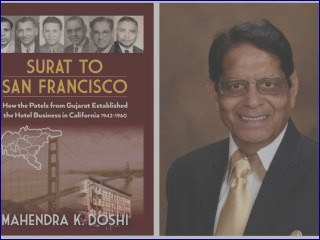
Author Mahendra Doshi explores this significant chapter of Indian-American history in his book, Surat to San Francisco. The book chronicles how the Patel community from Gujarat built a lasting presence in California’s hospitality sector.
Through detailed research and interviews, Doshi reveals the journeys of those who left their familiar lives behind in search of the American Dream. Their stories illustrate resilience, adaptation, and a deep commitment to family and community.
By focusing on the experiences of first-generation migrants and their children, Surat to San Francisco not only outlines business developments but also highlights how these families reshaped the American Dream — one room and guest at a time.
