
Breakthrough in Nuclear Physics: Astatine Isotope Decay Detected
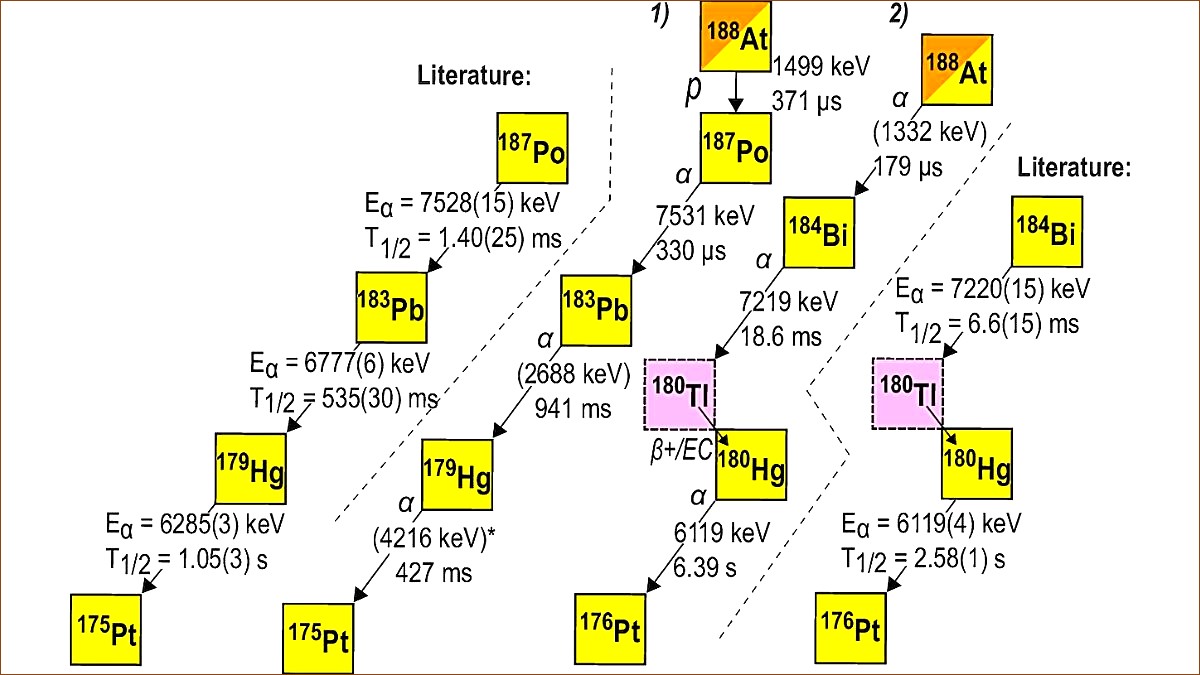
Nuclear physicists have made an exciting discovery by detecting the radioactive decay of a rare astatine isotope for the first time. This finding reveals that the heaviest naturally occurring element may behave in ways scientists had not anticipated, including the possibility of its transformation or even destruction. The unusual decay involves an atom with 85 protons and 103 neutrons, which is close to being stable yet remains unstable.
This important research was conducted by a team at the University of Jyväskylä in Finland. Their work sheds light on the intricate forces that contribute to the structure of heavy atomic elements.
On May 29, 2025, a report published in Nature Communications detailed how the isotope was created through a fusion-evaporation reaction, where a natural silver target was bombarded with strontium-84 ions. The resulting 188At isotope took on a unique "watermelon" shape due to interactions between neutrons and protons in its core.
Henna Kokkonen, a doctoral researcher involved in the study, noted that when one proton is emitted, the unstable nucleus can move toward a more stable state. Kokkonen also identified the 190At isotope while exploring rare decay phenomena in heavy nuclei, highlighting the complex energy interactions within these atoms.
The research team emphasized the importance of investigating new decay modes and testing theoretical models at the extreme ends of the periodic table. They also acknowledged advancements in technology that allow for the production and analysis of short-lived isotopes.
Discoveries like this are quite rare in the field of modern nuclear physics. Kokkonen expressed her pride in contributing to a global effort that enhances our understanding of atomic structures. Each new finding helps refine our awareness of nuclear forces, the formation of elements, and the very limits of matter itself. This breakthrough illustrates that, even after a century of nuclear research, the field still reveals unexpected wonders about the universe’s tiniest building blocks.
