
On Sunday, Prime Minister Narendra Modi launched several public transit and infrastructure projects in Delhi, totaling over ₹12,000 crore. This initiative comes just days before expected announcements regarding the state assembly elections.
During the event, Modi inaugurated a 13-kilometer section of the Delhi-Meerut Regional Rapid Transit System (RRTS) that connects Sahibabad in Uttar Pradesh to New Ashok Nagar in Delhi. He also unveiled the Janakpuri West-Krishna Park Extension segment of the Delhi Metro, marking the first phase of the network’s fourth expansion.
Modi laid the groundwork for the Rithala-Narela-Kundli corridor of the Metro and a new complex for the Central Ayurveda Research Institute (CARI) in Rohini. Later, while speaking at Japanese Park in northwest Delhi, he criticized the Aam Aadmi Party (AAP) government, referring to it as a disaster and assuring voters that the Bharatiya Janata Party (BJP) would continue public welfare programs if elected in the upcoming February elections.
The AAP responded by claiming that it has played a significant role in these projects and accused the BJP of failing to keep its promises to the people of Delhi.
This latest infrastructure boost follows a similar initiative on Friday, where Modi announced projects worth ₹4,500 crore, including housing for the underprivileged and new educational facilities.
On his inaugural ride on the newly launched RRTS, named Namo Bharat, Modi traveled from Sahibabad to New Ashok Nagar, marking the arrival of this rapid rail system to the capital. Once finished, the 82-km Namo Bharat line will connect Sarai Kale Khan in Delhi to Modipuram in Meerut. Modi previously launched sections of this route over the past year, with the full corridor expected to be operational by June 2025.
The Namo Bharat trains will significantly reduce travel time, offering a journey between Delhi and Meerut South in just 40 minutes, making it the fastest public transport option in the area. The trains are designed to reach speeds of up to 180 km/h, far exceeding the maximum speed of 80 km/h for regular Delhi Metro trains.
Ticket prices range from ₹150 for standard coaches to ₹225 for premium coaches. Modi announced that this new transit system will greatly enhance urban mobility in the region. He was joined by Delhi’s Chief Minister Atishi, Union Minister of Housing and Urban Affairs Manohar Lal, and Lieutenant Governor VK Saxena during the event.
Atishi also highlighted that the RRTS project has involved investments from the central government as well as the Delhi government, emphasizing the project’s importance for the economic growth of the region.
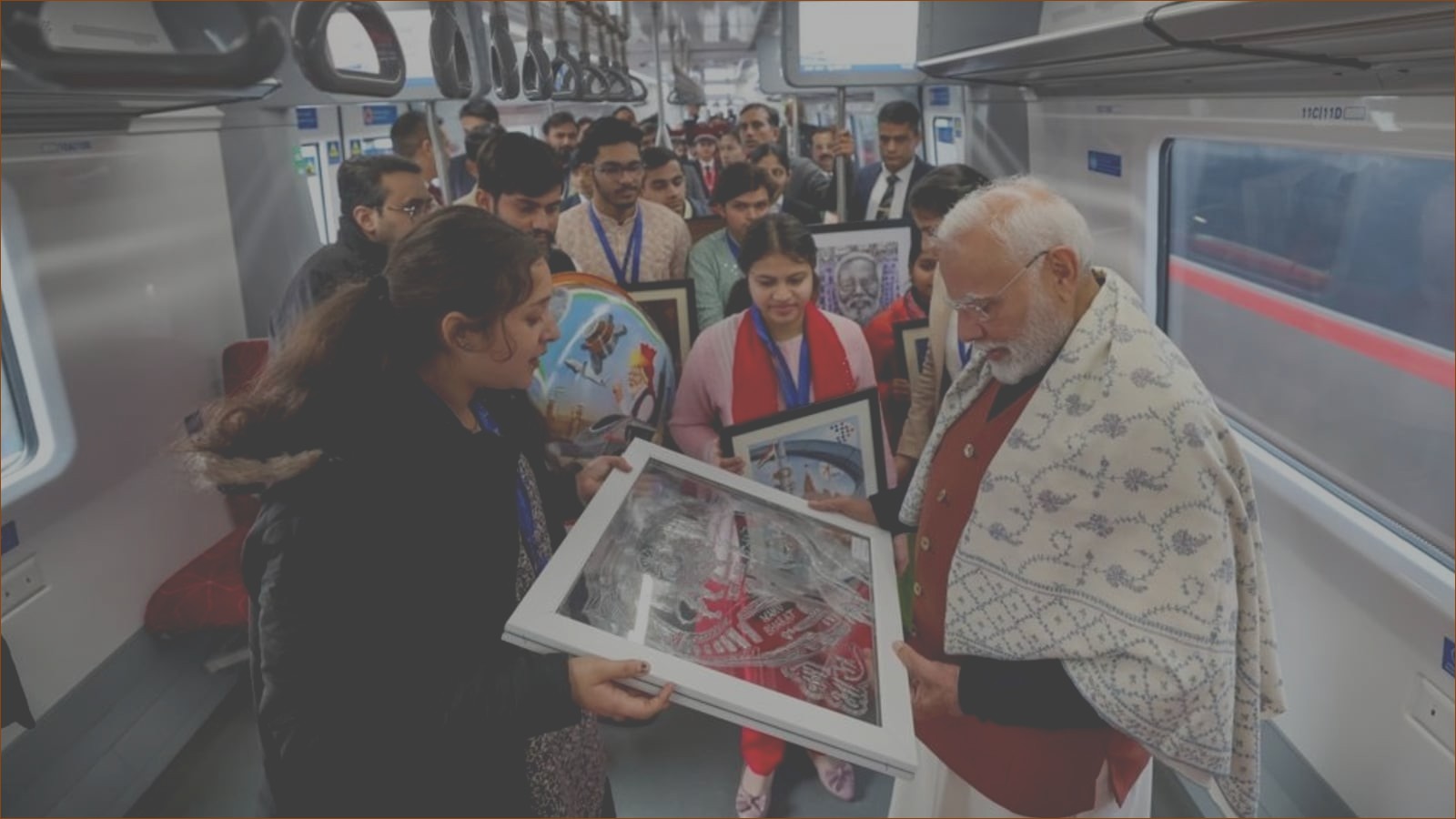
During his journey, Modi interacted with several passengers and received art pieces from some of them. Following this, he inaugurated the Janakpuri West-Krishna Park Extension section of the Metro, adding a new station to the capital’s growing Metro network, which now has 289 stations.
Modi further laid the foundation for the new CARI building, which will cost around ₹185 crore. During a public rally in Rohini, he spoke critically of the AAP government, asserting that the BJP was capable of developing Delhi.
Modi’s remarks resonated with many residents in the capital, who expressed their desire for change.
