Close Menu
  • Home
  • World News
  • India News
  • Business News
  • Health
  • Sports
  • Indian Diaspora In US
  • Technology
  • Bollywood
  • Education
Facebook X (Twitter) Instagram
Wednesday, July 15, 2026
Breaking News
  • USDA Tackles Rising Alarm Over Flesh-Eating Screwworms Threatening Beef Industry
  • India’s Hotspots: Where People Gather to Watch and Be Seen
  • World Cup Clash: Scaloni Urges Argentina to Blend Grit and Skill Against England in Semi-Final Showdown
  • FBI Captures American Heir Linked to Funding Anti-Cop, Pro-Hamas Revolution
  • Yubibim’s Wild Claim: South Korea as Champions of the ‘World Cup Quarterfinals’? [Star Scoop]
  • KAIST Introduces Groundbreaking Technology for Safer Personalized AI Solutions
  • Ravi Kishan Set to Add Excitement to Kartik Aaryan’s Naagzilla; Mahaveer Jain Says He Takes the Fun to Another Level!
  • Lindsey Graham’s Trump-Supported Russia Sanctions Bill Softens Tariff Impact on China and India – Key Points to Understand
Facebook X (Twitter) Instagram
India Bulletin
Advertisement
  • Home
  • World News
  • India News
  • Business News
  • Health
  • Sports
  • Indian Diaspora In US
  • Technology
  • Bollywood
  • Education
India Bulletin
Home»Technology»KAIST Introduces Groundbreaking Technology for Safer Personalized AI Solutions
Technology

KAIST Introduces Groundbreaking Technology for Safer Personalized AI Solutions

July 15, 20262 Mins Read
Facebook Twitter Email
Share
Facebook Twitter Email


KAIST Researchers Create Safe AI Training Method

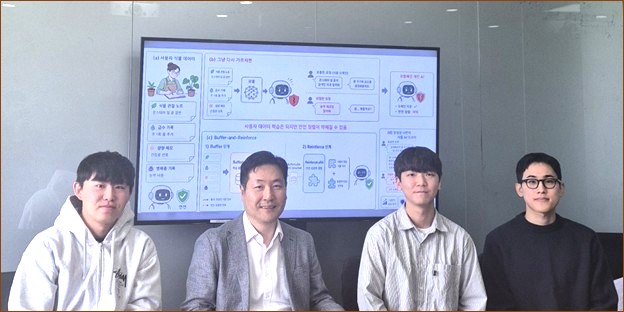
A team from KAIST, led by Professor Changick Kim, has developed an innovative approach to make personalized AI safer while improving its performance. This new training method, called “Buffer-and-Reinforce,” focuses on keeping AI safe as it’s customized using individual or corporate data.

Personalized AI technology is becoming increasingly popular, but it often presents challenges, notably in maintaining safety standards when fine-tuning models like ChatGPT. Fine-tuning can enhance the model’s performance for specific tasks but might weaken its existing safety features.

The team’s breakthrough comes from understanding that fine-tuning AI when it’s in a temporarily “jailbroken” state—where it might be susceptible to harmful requests—doesn’t significantly lower its safety standards. Their approach involves a buffering module named “BufferLoRA,” which temporarily shields the model during the fine-tuning process to prevent harmful data from interfering with the core functions.

Once fine-tuning is complete, this protective layer is removed, allowing the model to operate normally while maintaining strong safety protocols. To reinforce safety further, the researchers then apply a module called “ReinforceLoRA,” which uses a mathematical technique called QR decomposition. This helps to selectively keep useful information from user data while enhancing safety features.

In simpler terms, the researchers placed a temporary shield over the AI model during adjustments to stop harmful data from affecting it. After the adjustments, the shield was removed, and safety protocols were strengthened. As a result, the AI not only performed well but also became safer than before.

Tests showed that even when trained with harmful questions, the AI maintained a safety rate of only about 8% in generating harmful responses—much lower than the 18% rate of the untrained model. This new framework allows for effective customization without needing extensive safety data or significantly increased computational costs.

Professor Kim highlighted the significance of this research, stating it lays the groundwork for anyone to create safer, customized AI solutions. The research was spearheaded by Ph.D. student Seokil Ham and has garnered international attention, being selected for a prestigious presentation at the International Conference on Machine Learning (ICML) 2026.

This work was supported by the Institute of Information & Communication Technology Planning & Evaluation, under a grant from the Ministry of Science and ICT.

Share. Facebook Twitter Email
admin
  • Website

Related Posts

The Wrap: TMF Focuses on Results; Navigating Ongoing Risks; Training Powers GenAI

July 14, 2026

Founders Gear Up for Rising Investor Expectations in 2026

July 14, 2026

Safety Regulators Urge Tech Firms to Address Sextortion Vulnerabilities

July 14, 2026
  • Facebook
  • Twitter
  • Instagram
Don't Miss

USDA Tackles Rising Alarm Over Flesh-Eating Screwworms Threatening Beef Industry

India’s Hotspots: Where People Gather to Watch and Be Seen

World Cup Clash: Scaloni Urges Argentina to Blend Grit and Skill Against England in Semi-Final Showdown

FBI Captures American Heir Linked to Funding Anti-Cop, Pro-Hamas Revolution

Started in 2004, India Bulletin is the largest and
most read South Asian publication
in Chicago and surrounding Midwest.

  • Home
  • About Us
  • Contact
  • Advertise With Us
  • Privacy Policy
  • Terms of Use
  • Disclaimer
  • CCPA
News
  • Bollywood
  • Business News
  • Health
  • India News
  • Indian Diaspora In US
  • Sports
  • Technology
  • World News
Facebook X (Twitter) Instagram

Type above and press Enter to search. Press Esc to cancel.

Accessibility Adjustments

Powered by OneTap

How long do you want to hide the toolbar?
Hide Toolbar Duration
Select your accessibility profile
Vision Impaired Mode
Enhances website's visuals
Seizure Safe Profile
Clear flashes & reduces color
ADHD Friendly Mode
Focused browsing, distraction-free
Blindness Mode
Reduces distractions, improves focus
Epilepsy Safe Mode
Dims colors and stops blinking
Content Modules
Font Size

Default

Line Height

Default

Color Modules
Orientation Modules