
UQ Researchers Advance Real-Time Aerial Mapping Technology
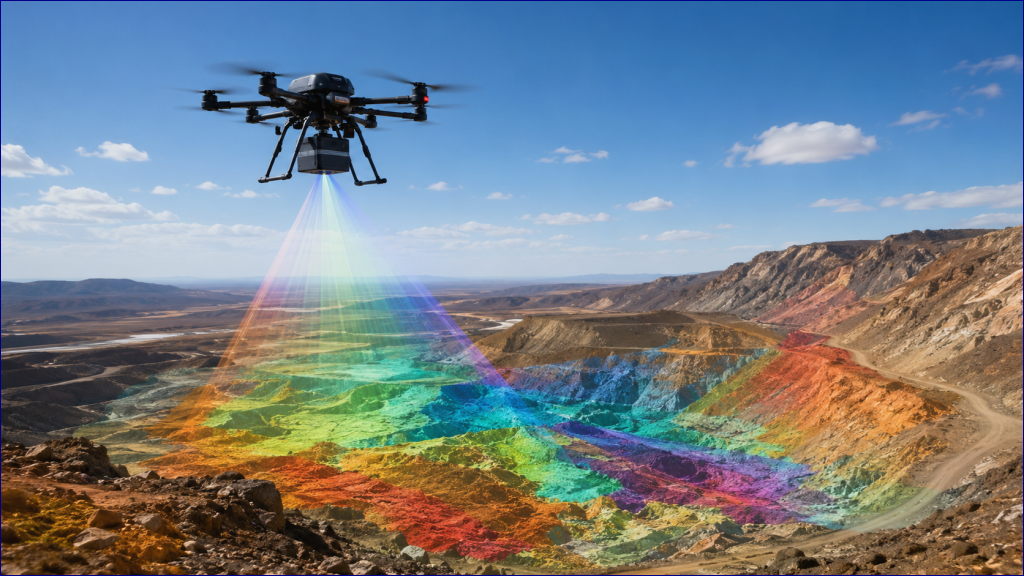
Researchers from the University of Queensland (UQ) have played a key role in creating a new hyperspectral imaging system that offers nearly immediate aerial mapping for mineral exploration and environmental monitoring. This innovative technology was developed through a European-led project known as the m4mining consortium, which has drawn praise from the European Commission for its significance in the mining industry.
The project united various research organizations and industry partners to design a drone-mounted hyperspectral imaging system capable of processing complex aerial data right after a survey. This means that exploration teams no longer have to wait weeks or months for results; instead, they can access useful datasets as soon as the drone lands, leading to quicker decisions in the field.
After successful testing in both Australia and Europe, the technology has been integrated into a commercial product by Norwegian imaging company Norsk Elektro Optikk AS, under its HySpex brand. This sets the stage for greater use of the technology in the global mining sector.
Speeding Up Exploration with Drone Technology
The UQ’s Sustainable Minerals Institute (SMI) provided critical expertise in geoscience, remote sensing, and industry during the m4mining project. They helped validate the technology through case studies in regional Queensland, with final testing taking place in Brisbane.
This drone-mounted system blends advanced remote sensing with smart data processing, allowing it to generate detailed three-dimensional models of survey sites while spotting patterns in minerals, soils, and vegetation. These surface features provide important clues about geological structures and potential mineral deposits beneath the surface.
Unlike traditional drone-based hyperspectral systems that typically need extensive processing before the data can be used, this new platform can perform complex calculations in-flight. This innovation significantly shortens turnaround times, enabling exploration teams to analyze survey results almost instantly.
Collaborative Efforts Yield Market-Ready Solutions
The m4mining consortium received €4.5 million from Horizon Europe to develop cutting-edge technology for mineral exploration, extraction, re-mining, and environmental monitoring. The project is led by the Norwegian research center NORCE, with support from imaging specialist Norsk Elektro Optikk AS and valuable contributions from the University of Queensland, connecting developers and the resources sector.
To ensure the technology met industry needs, SMI formed a minerals advisory board during the project, gathering feedback that informed the development process. This collaborative strategy was vital in refining the system to better fit operational requirements before it underwent final validation.
The European Commission’s review praised the consortium for delivering a fully integrated, validated, and market-ready solution for mining applications, underscoring its potential to revolutionize the collection and use of hyperspectral data in challenging environments.
Looking Ahead: Commercial Launch and Ongoing Research
The cutting-edge technology developed through m4mining is now part of HySpex’s upcoming BiFrost hyperspectral imaging platform, which is set to be publicly launched in the near future. The success of this project illustrates the importance of international collaboration among universities, research organizations, and industry in driving innovation within the mining sector.
Researchers at UQ are also working on enhancing hyperspectral imaging capabilities by merging drone-acquired data with satellite observations. This effort aims to improve the resolution and accuracy of satellite images, opening up new avenues for mineral exploration, environmental assessments, and extensive resource monitoring.
