
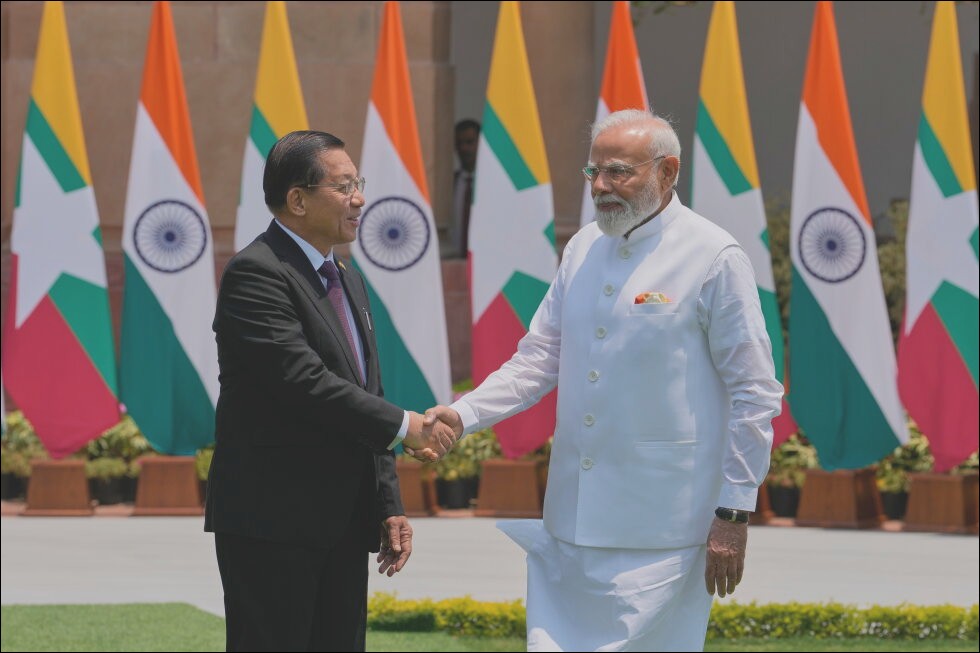
NEW DELHI — India has announced its intention to continue its diplomatic engagement with Myanmar, following a meeting between Prime Minister Narendra Modi and Myanmar’s military leader, Min Aung Hlaing. This comes despite the ongoing Western sanctions imposed after the military took control in Myanmar back in 2021.
Indian Foreign Secretary Vikram Misri commented that India’s approach is not meant to interfere with Myanmar’s internal politics. Instead, the nation’s stance is that open dialogue is more beneficial than isolation. He emphasized that past experiences show that stopping communication does not lead to better outcomes.
Min Aung Hlaing’s visit marks his first trip to India since taking office in April, after an election that many criticized as reinforcing the military’s grip on power. Before this, he last visited India in 2019 when he was the head of Myanmar’s military.
India shares a long border with Myanmar and has maritime ties in the Bay of Bengal. The neighboring country also hosts numerous refugees who have fled conflict in various regions of Myanmar, such as Chin state. Myanmar’s significance to India extends to security, as both nations have worked together on border safety and intelligence sharing to combat insurgent groups.
While Modi and Min Aung Hlaing did not address reporters after their discussions, Misri revealed that their conversation covered a range of topics, including trade, defense, security cooperation, and border management. They also focused on enhancing economic and technological partnerships, agreeing to collaborate further in fields like energy and critical minerals, as well as speeding up key connectivity initiatives.
Additionally, they touched on the fight against cybercrime and human trafficking, critical issues affecting many Indians in the region. In the last 18 months, India and Myanmar have worked together to rescue over 2,400 Indian citizens caught in scams in the area.
During his trip, Min Aung Hlaing also met with Indian President Droupadi Murmu, Foreign Minister Subrahmanyam Jaishankar, and National Security Adviser Ajit Doval.
