
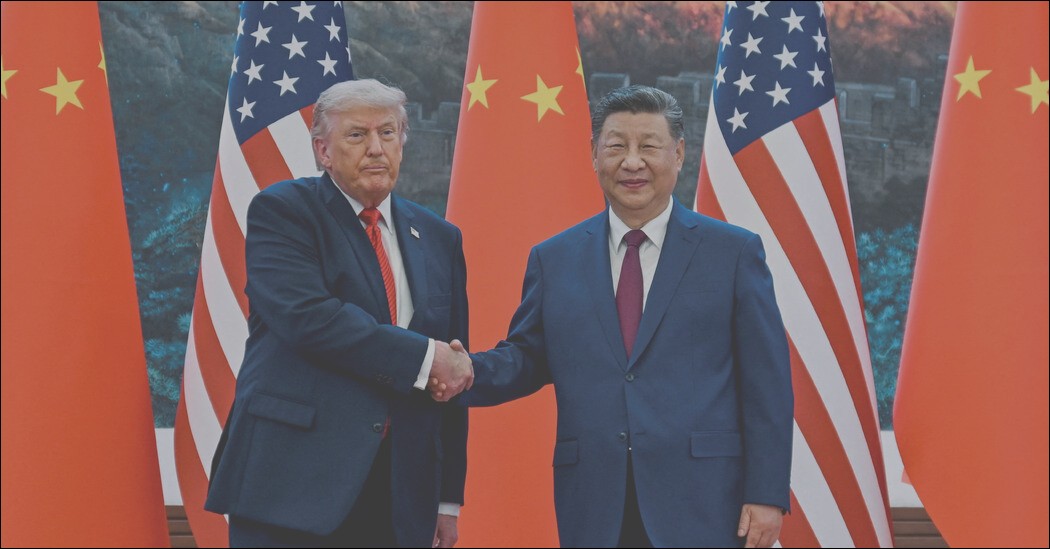
Trump and Xi: A Diplomatic Dance Amidst Tensions with India
Last week in Beijing, President Trump took a moment to praise Xi Jinping, the leader of the Chinese Communist Party, describing him as a “great leader” and “a friend.” Despite a grand military honor guard and enthusiastic local schoolchildren, Trump announced that he and Xi would have “a fantastic future together.”
After his visit to China, Trump returned home without addressing any other Asian nations. His interviews during and after the trip didn’t offer much reassurance to U.S. allies in the region. He mentioned he would reconsider arms sales to Taiwan, raising concerns in Asia about U.S. security commitments, especially among Indian leaders.
In the absence of a direct meeting with Trump, Indian officials are focusing on hosting Secretary of State Marco Rubio. Rubio’s four-day visit kicked off with a visit to a charity in Kolkata and discussions with Indian Prime Minister Narendra Modi in Delhi. During their talks, Rubio extended an invitation from Trump for Modi to visit the White House, emphasizing the need for stronger trade and defense ties.
As Rubio travels across India, he will clarify the administration’s Asia strategy, especially since Trump appears eager to strengthen ties with Xi while downplaying security issues related to China. Rubio will also meet with diplomats from Japan and Australia, who are visiting for a Quad partnership meeting.
This visit comes in light of earlier tensions when Trump imposed high tariffs on Indian imports after Modi declined to support his bid for the Nobel Peace Prize. Trump had claimed he played a vital role in mediating a ceasefire between India and Pakistan after a series of military skirmishes.
Current relations between India and the U.S. are not what they used to be. While previous administrations sought to solidify their alliance, Trump’s approach has shifted dynamics, prompting Indian leaders to explore better relations with China after noticing a decrease in U.S. backing.
“There’s significant worry about the changing direction of India-U.S. relations,” said Ananth Krishnan, a resident of Beijing and author on India-China relations. He noted that despite the existing connections in defense and technology, the perception of India as a key partner has changed.
Adding to the confusion, Trump recently referred to the U.S. and China as “G2” in a Fox News interview, positioning them as the “two great countries.” His history of admiration for authoritarian leaders contrasts starkly with Modi’s democratic governance, although Modi’s leadership style is often described as increasingly autocratic.
The bond between Modi and Trump has experienced ups and downs. In 2020, Modi even hosted a huge rally in support of Trump in India, calling attention to the special relationship between the two countries. However, after a call last summer where Modi asserted India had handled its issues with Pakistan independently, Trump’s frustration led to steep tariffs on Indian goods.
Now, Secretary Rubio faces a monumental task of rebuilding U.S.-India relations. Close Trump ally and newly appointed Ambassador to India, Sergio Gor, will play a role in this initiative. Observers note that increasingly, the current Trump administration does not prioritize India in their strategic plans.
With Trump’s unpredictable nature, many Indian officials suggest that preserving their traditional policy of “strategic autonomy” has become more important. This means keeping a careful distance from major world powers.
Indian officials have recently expressed concern over comments made by U.S. diplomats suggesting that India could be seen as both a strategic and economic threat. This shift in attitude has not gone unnoticed, prompting the Indian government to publicly criticize insensitive remarks from the U.S.
As Rubio meets with Indian leaders, they aim to clarify the Trump administration’s view on their relationship with both India and China. There are shared worries regarding Washington’s willingness to foster a “constructive relationship” with Beijing.
Relations between India and China have been strained, particularly after military clashes in 2020, but both nations seem to be trying to stabilize their ties. Recent easing of travel restrictions and discussions for more Chinese investment in India’s economy signal potential reconciliation.
While the road ahead for India-China relations remains complex, experts believe there is potential for improvement, especially regarding border issues. If these are addressed positively, it could pave the way for a more robust relationship moving forward.
