
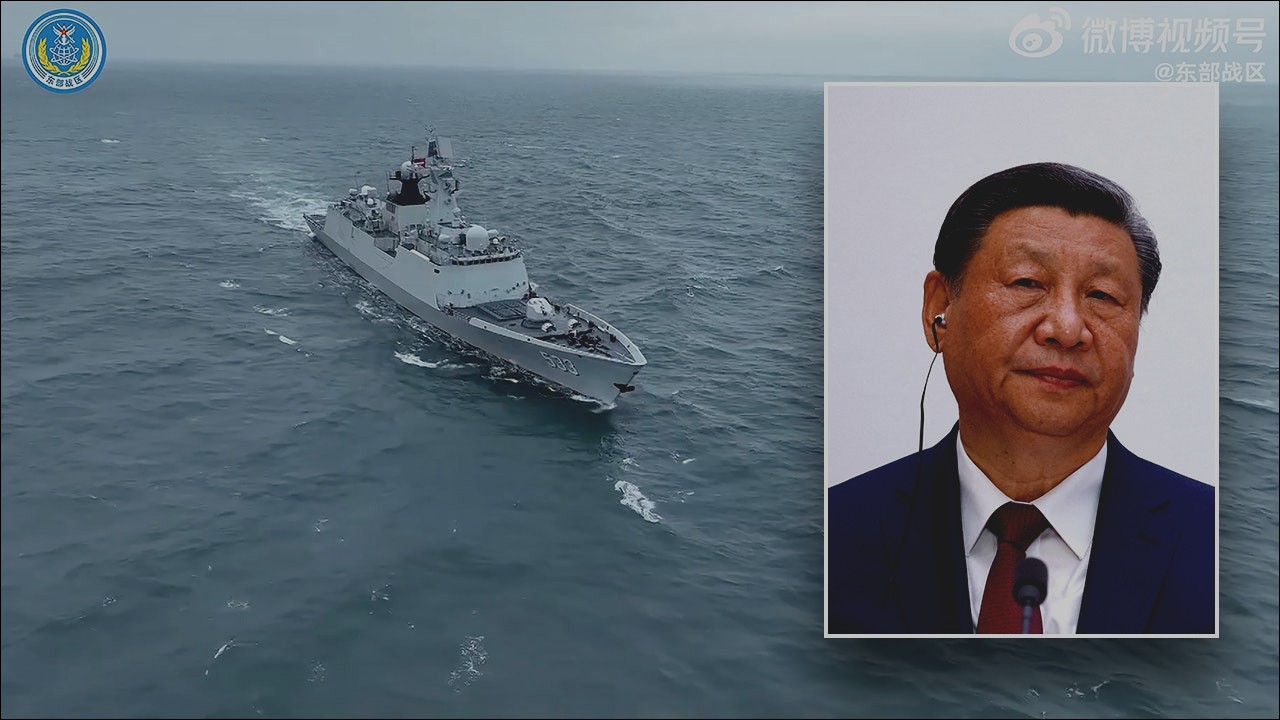
KAOHSIUNG, TAIWAN – In a striking divergence from mainstream media narratives, China’s recently conducted 13-hour simulated blockade of Taiwan, which commenced on October 14—replete with an unprecedented array of aircraft, naval vessels, and even an aircraft carrier—transcends a mere punitive action against Taiwan’s newly inaugurated President William Lai. His remarks since taking office in May might have sparked discussions, but the underlying motivations for Beijing’s military exercises delve much deeper.
"China meticulously orchestrated these exercises well ahead of time," elaborated Elizabeth Freund Larus, a nonresident senior fellow at the Atlantic Council Global China Hub, in her conversation with Fox News Digital. "These maneuvers aim to systematically degrade Taiwan’s military capabilities and instill a sense of insecurity within its populace, eroding their trust in the government while ultimately seeking to redefine the delicate status quo that separates Taiwan from China."
While these justifications might align logically from Beijing’s strategic viewpoint, Dr. Chang Ching—senior research fellow at the R.O.C. Society for Strategic Studies and a veteran of the Taiwanese Navy—contends that the broader implications are often overlooked. He cited military records from Japan that tracked the movements of both Russian and Chinese naval units days before the residency blockade began.
TAIWANESE PEOPLE READY TO FIGHT AS CHINA RAMPS UP AGGRESSION, AMBASSADOR SAYS
A press release by Japan’s Ministry of Defense on October 14 indicated that, as early as October 11, they had identified six vessels—four Chinese and two Russian—navigating approximately 400 kilometers northeast of Okinotorishima Island. This suggests a coordinated military presence predating the blockade, compelling Chang to assert, "These ships weren’t merely involved in harassment of Taiwan; their true objective was the United States."
"They were employing an age-old Chinese military strategy—’encircling the point, striking the reinforcement’—to practice ambushing U.S. forces should they choose to intervene in a Taiwan already under duress. If China can successfully dissuade the U.S. from intervening, Beijing essentially secures a victory," he articulated.
This sentiment reverberated among local experts, with Taiwan’s Central News Agency relaying insights from Lin Ying-yu, an assistant professor at Tamkang University. He posited that China’s timing is deliberately provocative, aimed at gauging the United States’ capacity to respond to simultaneous crises in both the Korean Peninsula and the Taiwan Strait.
CHINA SEEKS TO ‘WEAR DOWN TAIWAN’S RELIANCE’ WITH COVERT ECONOMIC AND CYBER OPERATIONS, US WARGAMERS SAY
According to various metrics, the Chinese Navy either ranks as a formidable second following the U.S. Navy or may even outstrip it in terms of sheer capacity. Yet, analysts like Chang caution against underestimating the Chinese naval forces, which many dismiss as lacking experience. Instead, they field a flourishing fleet composed of more modern vessels—over 70% of them launched post-2010, while merely a quarter of U.S. warships fit this timeline, according to the Center for Strategic & International Studies.
In stark contrast to prior maneuvers, Joint Sword 2024B unfolded without customary advance notifications or well-defined operational parameters, amplifying its aura of intimidation. The ambiguous timeline surrounding the exercise’s conclusion only served to heighten anxieties.
Paradoxically, during this orchestrated incursion, the atmosphere in Taiwan appeared surprisingly tranquil. Few citizens expressed outright fear, leading some to speculate that a concerning acceptance of vulnerability might be taking root—the increasing belief that Taiwan’s defenses are ineffectual against the looming threat from the mainland, especially considering that Joint Sword 2024B brought forces within a mere 24 nautical miles of its shores.
Notably, China’s heavily armed Coast Guard also played a role in these exercises, featuring numerous vessels that blur the lines between coast guard functions and military operations. These ships are not merely for show; some boast armaments capable of delivering powerful threats, with large vessels equipped to reach impressive speeds.
Adding a grim twist of irony to the unfolding narrative, Chinese officials released an image on platforms like Weibo showcasing a simulated route around Taiwan shaped like a heart, captioned with an unsettling message—"Hello my sweetheart! Our patrol is our way of loving you." This has been described by Larus as "macabre" and interpreted by Chang as emblematic of China’s troublingly possessive stance toward Taiwan.
TAIWAN REACTS TO TRUMP’S THEY ‘SHOULD PAY US FOR DEFENSE’ COMMENTS
Recent surveys indicate a palpable expectation among Taiwanese citizens, with around 70% anticipating U.S. assistance in the event of military aggression from China. However, American reactions to Joint Sword 2024B have been characterized as tepid and tumultuous—casting shadows of uncertainty among Taiwan’s populace.
"The United States harbors serious concerns over the People’s Liberation Army’s joint military exercises in the Taiwan Strait and surrounding areas," stated State Department spokesperson Matthew Miller. "Such provocative military actions in response to routine engagements are unwarranted and risk escalating tensions."
FOR CHINA’S MILITARY PLANNERS, TAIWAN IS NOT AN EASY ISLAND TO INVADE
In a pointed communication, the State Department’s Asia Pacific Media Hub underscored its vigilance regarding PLA activities: "We are closely monitoring JOINT SWORD 2024B exercises; this kind of military pressure is irresponsible and destabilizing."
There’s palpable frustration in Taiwan regarding the use of the term "disproportionate," especially when considering that Taiwan has not instigated actions that would warrant even a proportionate response. With an American presidential election looming, analyses suggest that all statements from Washington are being meticulously crafted, leading to perplexity, especially regarding terminology that seems out of step with Taiwan’s actual military posture.
Given the context in which any act by Taiwan is perceived through the lens of Beijing’s narrative of "pro-independence provocation," there’s a palpable call for global democracies, particularly the U.S., to unite in response to China’s persistent confrontational moves, aimed at undermining Taiwan’s hard-fought autonomy.
Kitsch Liao, Assistant Director at the Atlantic Council’s Global China Hub, emphasizes the urgency for Taiwan to revamp its National Security Strategy, advocating for an updated approach to navigate these rapidly shifting geopolitical tides while working toward shared stability in the Taiwan Strait.
