
SpaceX’s Latest Starship Launch Marks Positive Step Ahead of $1.75 Trillion IPO
May 27 (Reuters) – SpaceX’s recent Starship launch on Friday has kept the excitement alive for Elon Musk’s anticipated $1.75 trillion initial public offering (IPO). While the path to achieving full reusability of the rocket is still underway, this test showed enough promise to reassure investors.
The Starship program is essential for reducing SpaceX’s launch costs and expanding its Starlink satellite business, which is a key source of revenue. The rocket’s success is also crucial for future plans, including space-based computing, AI satellite deployments, and potential human missions to the Moon and Mars.
Mark Vena, CEO of SmartTech Research, mentioned, “SpaceX didn’t need this flight to be perfect. They just needed to show that the upgraded vehicle is heading in the right direction, and that’s mostly what investors were looking for.”
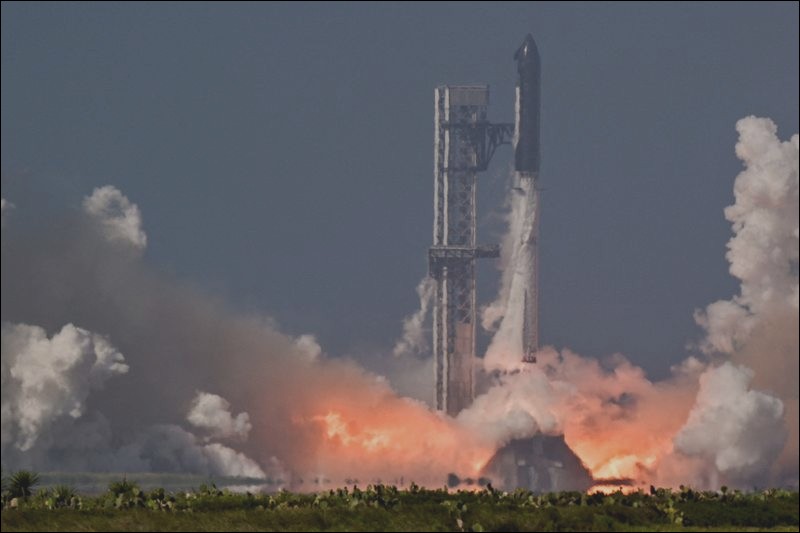
SpaceX has invested over $15 billion in developing a fully reusable rocket designed to carry heavier payloads than current systems can manage. The test on Friday, which was the 12th Starship prototype flight since 2023 and the first of its V3 model, had several successes. It successfully deployed mock satellites and made a controlled splashdown in the Indian Ocean. However, the Super Heavy booster did not land as intended, tumbling into the Gulf of Mexico.
Vena stated that even with some setbacks, the test may strengthen the investment outlook if it shows progress towards full reusability. Investors and analysts are optimistic about the IPO, relying on Musk’s track record of transforming risky engineering projects into successful businesses.
James Bruegger, chief investment officer at British investment firm Seraphim Space, emphasized, “Full reusability is crucial for significantly lowering launch costs. That is where the real value lies.”
Despite the positives, the company has cautioned that delays in development could affect the rollout of next-generation satellites and AI infrastructure. Some investors worry that Starship could fall into a cycle of repairs and failures without proving a reliable system.
Jesse Nacht, a research associate at MarketVector Indexes, pointed out, “The Starship launch reduced concerns that the program is stuck in a cycle of failure. While risks remain, any significant issues would likely not change overall expectations.”
Antoine Grenier, head of space consulting at Analysys Mason, described this outcome as “lukewarm success,” which he believes might be the best-case scenario. He noted that a total failure would have been problematic, while complete success could have led to excessive IPO hype.
With a seven-month gap since the last flight, SpaceX needed this launch before the IPO to avoid raising concerns among investors about the pace of development. The roadshow for this highly awaited IPO is scheduled for June 4, with the potential to raise up to $80 billion, making it the largest in history.
Investors are reevaluating SpaceX not just as a launch company, but as a potential future provider of AI infrastructure. Musk recently defended the trajectory of xAI, highlighting that the young company is still in its early stages compared to competitors like OpenAI and Anthropic.
Currently, analysts believe SpaceX has more work ahead to prove that Starship can operate effectively and economically on a larger scale. Austin Moeller, managing director of equity research at Canaccord Genuity, stated, “SpaceX must demonstrate reliable launches, successful payloads, and safe recoveries to enable the setup of a massive constellation of orbital data centers.”
