
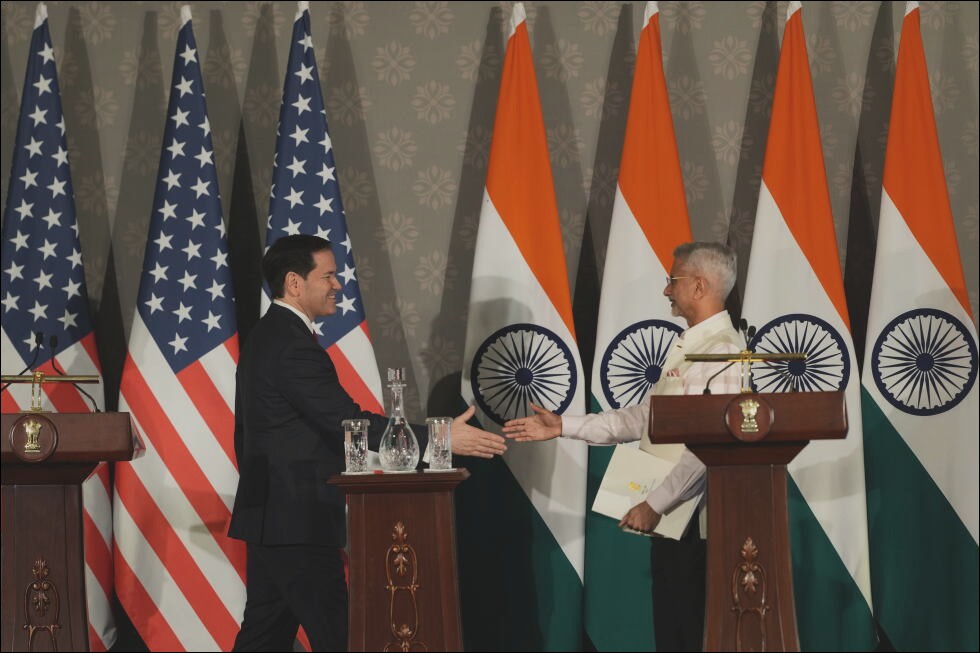
U.S. Secretary of State Meets Indian Foreign Minister Amid Strained Relations
NEW DELHI — U.S. Secretary of State Marco Rubio held discussions with Indian Foreign Minister Subrahmanyam Jaishankar on Sunday, aiming to strengthen ties that have recently hit a low point. This is Rubio’s first official visit to India, occurring during a time when economic and diplomatic relations between the two nations are facing challenges.
The U.S.-India relationship has been affected by U.S. tariff policies introduced under President Donald Trump, which have raised duties on various Indian goods. In the coming days, Rubio plans to meet with his counterparts from Australia and Japan in New Delhi, forming part of the Quad strategic alliance focused on the Indo-Pacific region.
Strengthening the U.S.-India Partnership
Following their initial talks, Rubio and Jaishankar emphasized the importance of enhancing the U.S.-India strategic partnership while respecting each country’s national interests. Rubio highlighted India as a key partner for the United States and expressed hope for a bilateral trade agreement to be finalized soon. “Our relationship with any country doesn’t come at the cost of our friendship with India,” he stated, optimistic about future developments in U.S.-India relations.
Jaishankar remarked that the strategic partnership is underpinned by shared national interests. He pointed out that while the Trump administration has adopted an “America First” approach, India has its own “India First” perspective. This reflects both nations’ focus on their respective priorities.
Discussing energy needs, Jaishankar mentioned that India requires multiple reliable and affordable energy sources for its vast population. He indicated that the U.S. could be a vital source, alongside other countries, as India diversifies its energy imports.
Navigating Complex Challenges
In recent months, India has engaged in multiple trade agreements, including ones with Oman, New Zealand, and the UK, along with an important deal with the European Union. These moves highlight India’s commitment to broadening its trade relationships.
On geopolitical matters, specifically concerns related to the Strait of Hormuz, Jaishankar stressed the need for secure maritime trade and affordable fuel supplies. He expressed that India aims to keep its energy markets open and competitive.
Experts have noted that despite historic ties, there are underlying tensions in U.S.-India relations. Ashok Malik, a former policy adviser in India’s Foreign Ministry, mentioned that recent statements from Washington regarding India’s security and trade have strained trust. He suggested that Rubio’s visit may help stabilize the relationship but acknowledged that some concerns will linger.
The complexities of U.S.-India relations reflect a balance of strategic interests. Both countries face challenges, including China’s assertiveness in the Indo-Pacific, highlighted through their collaboration in the Quad.
According to experts, while tensions exist due to differences in global ambitions, the long-standing partnership between the U.S. and India continues to evolve, shaped by mutual concerns and global dynamics. Moving forward, many hope to see a return to a more stable relationship, especially after the upcoming U.S. presidential elections.
Upcoming Events
Rubio’s visit will include a tour of various cities and a gala reception in New Delhi to commemorate the 250th anniversary of U.S. independence. His discussions in the coming days will be closely watched as both nations work to navigate their complex relationship.
This visit represents another attempt to bridge gaps and strengthen ties amid ongoing global challenges.
