
New Terahertz Filters by Lepto are Revolutionizing Satellite Communications
Lightweight Components for Costly Launches
Lepto GmbH has developed groundbreaking terahertz filters that are incredibly thin—about one micrometer thick—making them ideal for advanced satellite communications. Satellite companies are particularly keen on these lightweight components, especially given the high costs associated with launching equipment into orbit.
A Major Breakthrough in Terahertz Technology
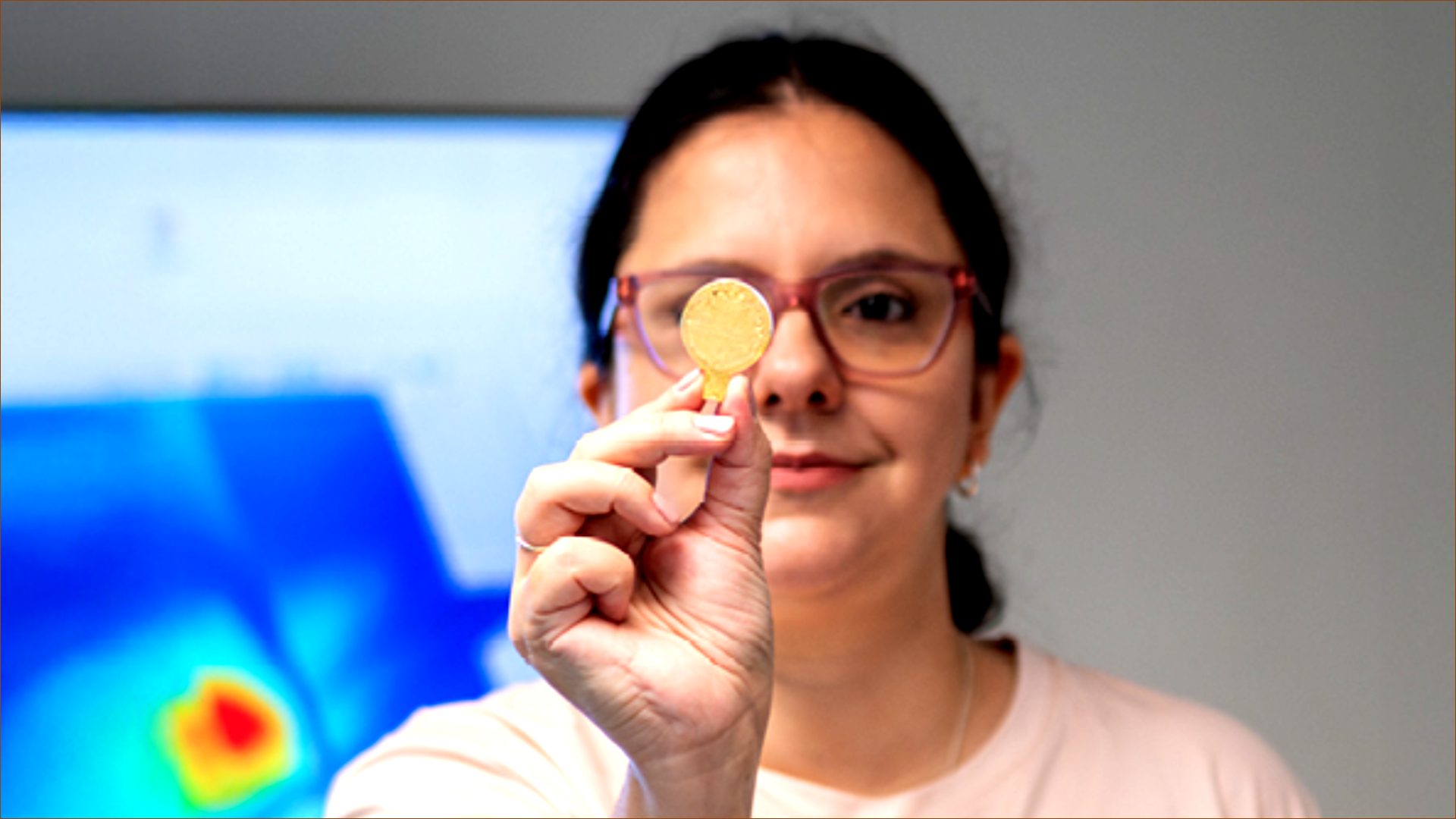
This filter may seem unassuming, with its reflective gold, red, and green surface, but it marks a significant advancement in terahertz radiation technology. Founded by researchers Elena Mavrona and Erwin Hack, Lepto GmbH turned years of lab research at Empa into a promising business venture after discovering strong interest from various institutions in their filters.
From Research to Market Demand
“We didn’t initially intend to launch a company; however, the inquiries we received highlighted a clear market demand,” said Erwin Hack, the company’s CTO. The founders realized that their product could not only benefit academic labs but also serve broader industries, particularly in satellite technology.
Exploring New Possibilities
Terahertz radiation, which falls between visible light and radio waves, has been largely overlooked. With wavelengths ranging from 0.03 to three millimeters, this band has traditionally been hard to access. The new Lepto filter changes that, combining extreme thinness with effective design. “We use 3D printing to create customized frames for our filters, which allows us to produce complex systems that are both lightweight and high-performing,” Mavrona explained.
Enhanced Communication and Security for Satellites
Advantages for Space Missions
In the realm of space technology, where each gram sent into orbit incurs significant costs, terahertz radiation presents major benefits. This technology offers improved material analysis for space research while also providing secure communication channels.
Hack noted that these higher frequency waves enable quicker data transfer, while their limited range makes them harder to intercept. “Terahertz radiation is not only vital for communication between satellites but also for communication from satellites to the ground,” he pointed out.
Terahertz in Everyday Applications
Back on Earth, while the technology faces some limitations due to atmospheric interference, experts see terahertz waves playing a vital role in the upcoming 6G standard. This new standard aims to offer faster and more energy-efficient connectivity compared to current 5G networks.
Beyond telecommunications, terahertz radiation is also being explored for medical uses, like skin cancer detection and evaluating superficial tissues without the harmful effects of X-rays. Airport security scanners could become another key application for this innovative technology.
Looking to the Future
Currently, most of Lepto’s customers are in the research sector, focusing on fields like spectroscopy and quantum computing. However, the founders are eager to transition from academic interest to commercial orders. “We’re excited to bring our products to the market,” they said, expressing optimism while actively seeking initial funding.
The potential for this technology to scale beyond specialized labs remains a pivotal question for the future.
