
Surge in Indian Emigration: An Evolving Landscape
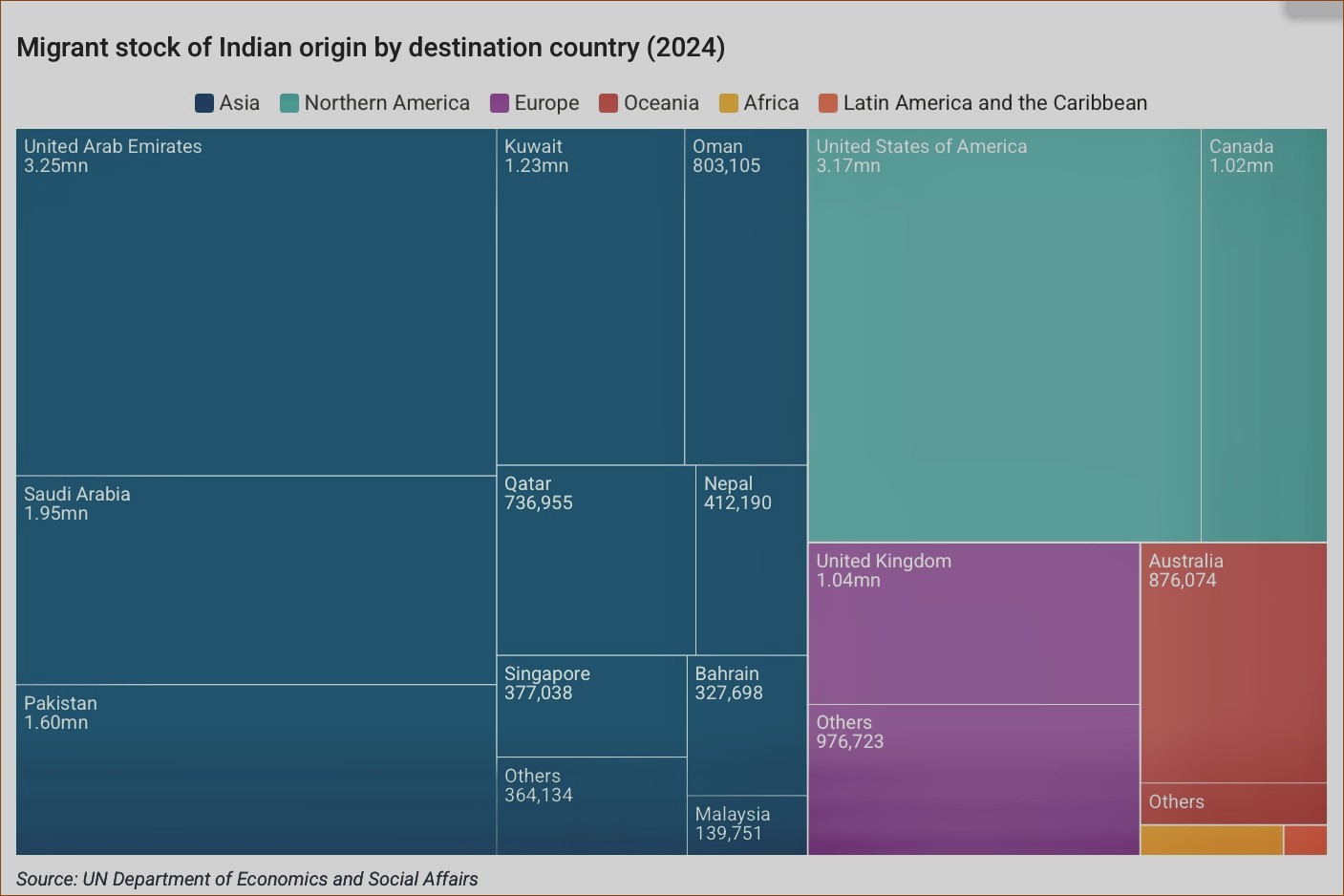
A recent report reveals that Indians have become the largest group of emigrants worldwide, with significant changes in their preferred destinations over time. By 2024, the United Arab Emirates (UAE) and the United States (USA) are projected to be the top choices for Indian emigrants.
Both the UAE and the USA currently host about 17% of the over 18.5 million individuals of Indian origin living abroad. This large group represents approximately 6% of all international migrants across the globe.
Approximately one-quarter of Indian emigrants reside in North America, a trend that has increased as more Indians also migrate to countries like Australia and New Zealand. Although migration to Europe has risen in numbers, its overall share of Indian migrants has decreased.
The majority of Indian emigrants still relocate within Asia, particularly to West Asian nations. The Gulf Cooperation Council (GCC) countries—Bahrain, Kuwait, Oman, Qatar, Saudi Arabia, and the UAE—accommodate nearly half of all Indian emigrants.
From 1990 to 2024, the Indian emigrant population tripled, jumping from 6.5 million to 18.5 million. Their global share among emigrants rose from 4% to 6%.
A large part of this emigration is tied to the historical context of the 1947 Partition. Previously, many Indian-origin individuals in Pakistan were part of this out-migrant group, but this number has declined steadily. Currently, about 1.6 million Indian-born individuals live in Pakistan, comprising nearly 9% of Indians residing abroad in 2024.
In 1990, Saudi Arabia was the top destination for Indian-born migrants, but by 2024, the UAE and the USA have overtaken it. As a result, Indians now account for nearly 40% of the UAE’s immigrant population and a significant portion of Saudi Arabia and Kuwait’s populations as well.
Indian migrants are also increasingly moving to Canada, Australia, and New Zealand. They represent the largest migrant group in Canada and the second-largest group in the USA, following Mexicans.
By 2024, more than one-third of Indian migrants are expected to be women, rising from 2.6 million in 1990 to 6.6 million. The migration patterns display notable differences by gender. While many men tend to move to GCC countries, women often choose the USA, where almost a quarter of Indian migrant women reside.
In contrast to the GCC nations, where male migrants significantly outnumber female migrants, the ratio of Indian men to women in the USA and the UK is nearly equal.
India does not keep official records of its emigrant population. Instead, estimates are sourced from data compiled by the United Nations Department of Economic and Social Affairs (UN-DESA), which utilizes information from various destination countries.
To summarize, the Indian emigration trend highlights a dynamic shift in where Indians choose to live and work, showcasing the broader impacts of globalization and migration policies.
